20250213_La_Valse_MCB _DSC0003
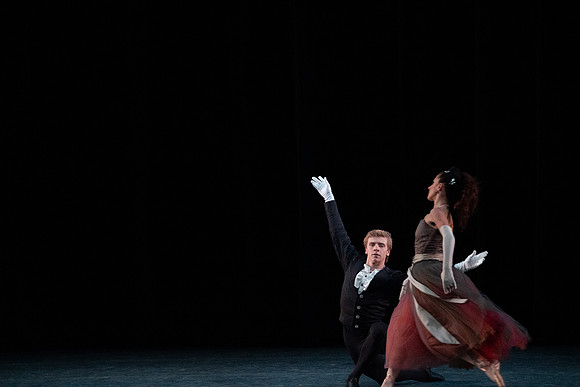
La Valse George Balanchine © The George Balanchine Trust. La Valse, celebrating 20 years in our repertoire, is haunting and hypnotic—a decaying waltz that unravels into dark mystery, set to Maurice Ravel’s mesmerizing score.
The stage is a dark and mysterious ballroom in which thirty-four dancers waltz in flowing romantic tutus to the powerful and disturbing music of Ravel. La Valse, a neo-romantic ballet choreographed by Balanchine in 1951, projects a mood of impending doom. Ravel wrote of the score, Valses Nobles: “We are dancing on the edge of a volcano,” and dance critic Arlene Croce wrote that the ballet “is about waltz intoxication, vertigo, and death.”
Although Balanchine’s ballet is considered plotless, it contains many dramatic elements that culminate with the appearance of a dark figure of Death who claims the life of a young woman dressed in white as the horrified on-lookers swirl about her upraised body. The girl in La Valse was the signature role of Tanaquil LeClercq whose career was tragically brought to a close when she contracted polio – a macabre parallel to the fate of the character whose death she danced so movingly.Unlike traditional ballet narratives where a young woman attends a ball and falls in love, La Valse presents a darker, more ominous vision. The ballet unfolds in a grand yet unsettling ballroom, where couples waltz in a hypnotic and increasingly chaotic dance. A woman in white becomes mesmerized yet horrified by a mysterious figure—Death itself. As her fascination deepens, Death gains control over her, stripping away her innocence with each piece of dark clothing she dons. Ultimately, she succumbs entirely, and the ballet ends with her demise. Ravel’s La Valse is not just a tribute to the waltz but also a haunting reflection of a world unraveling, mirroring the devastation and disillusionment left in the wake of World War I.
George Balanchine (1904-1983) was a Russian-American choreographer, widely regarded as the