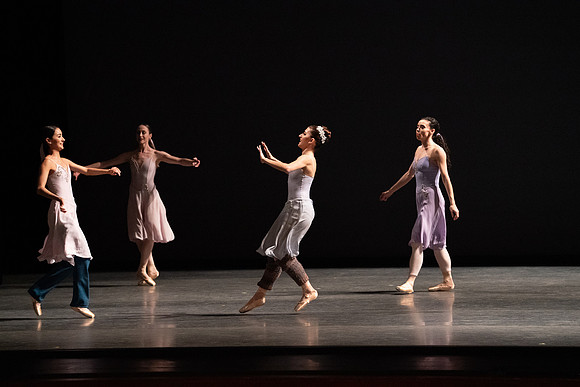
20250213_Walpurgisnacht_Ballet_MCB _DSC2762
Walpurgisnacht Ballet brings a whirlwind of energy as two dozen powerhouse women take the stage in a dazzling display of strength and speed. Originally created for the opera Faust, this piece is Balanchine at his most exhilarating. wenty-four girls stampeding across the stage – most of them in purple, their hair flowing – and a single man. Gounod’s passionate Faust music. A bravura ballerina role demanding both complete control and utter abandon (hand-tailored in 1980 for the great Suzanne Farrell). There’s no Faust, no Mephistopheles – just sheer impetuosity and startling virtuosity. This is Balanchine at his most outrageously popular – marrying classicism to kitsch!. Karinska,
Choreography
George Balanchine © The George Balanchine Trust
Music
Charles Gounod, From Faust (1859), ballet music added in 1869
Costume Designer "I attribute to (Karinska) fifty percent of the success of my ballets to those that she has dressed." — George Balanchine
Varvara Andryevna Zhmoudsky, later known as Karinska, (1886-1983) was born in Ukraine in 1886. She learned Victorian embroidery from German and Swiss governesses before studying law at Kharkiv Imperial University. After moving to Moscow in 1916, she became deeply involved in the arts, hosting influential salons attended by leading figures of the Russian cultural scene.
Karinska eventually relocated to Paris, where she began designing costumes for Ballet Russe de Monte Carlo, including works by George Balanchine. Their collaboration flourished, leading to more than 75 ballets together, including Serenade and Jewels.
One of her most revolutionary contributions was the “powder puff” tutu, created for Balanchine’s Symphony in C in 1950. This softer, fuller tutu allowed for greater movement and became a defining element of ballet costume design. Company Premiere February 10, 2017. Lighting Design John Hall.